A Floor That Became a Ceiling
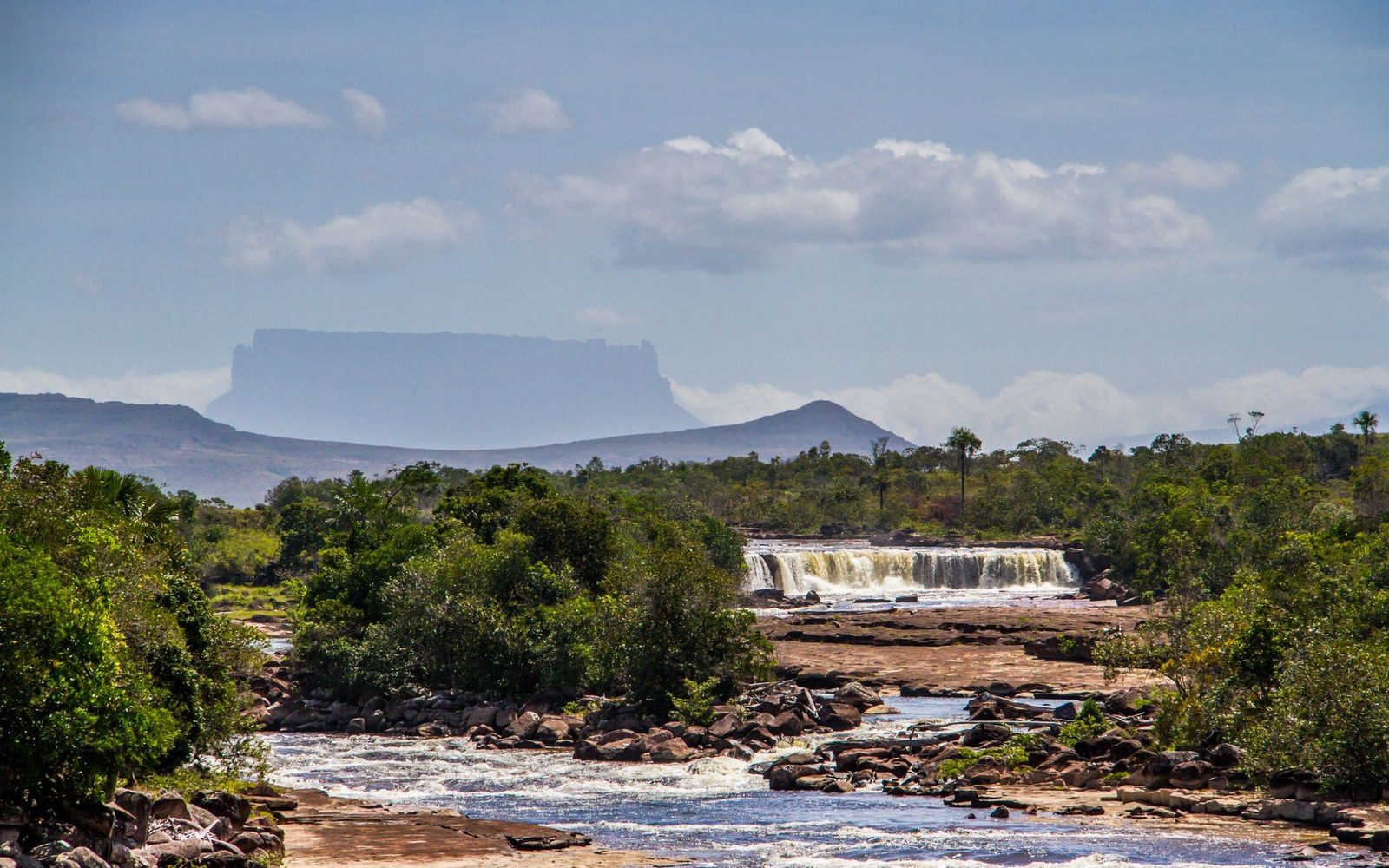
The rock forming Venezuela's tepuis — those extraordinary flat-topped mesa plateaus rising from the surrounding jungle — is among the oldest exposed stone on Earth. The Guiana Shield, the geological foundation beneath the Guiana Highlands, is a craton: a fragment of ancient crust that has remained tectonically stable since the Precambrian, the interval of geological time ending approximately 541 million years ago. The quartzite and sandstone of the tepuis themselves belong chiefly to the Roraima Supergroup, a sequence of sedimentary layers deposited between roughly 1.7 and 2 billion years ago, when the supercontinent of Columbia was assembling across what is now equatorial South America.
Those sediments — fine siliceous sands and silts laid down in shallow basins and ancient river systems — were subsequently buried, compressed and cemented into the hard, erosion-resistant quartzite and sandstone that defines tepui summits today. Around them, softer Proterozoic and more recent rocks were worn away by hundreds of millions of years of rainfall, chemical weathering and river action. What the geomorphologists call differential erosion did the rest: the harder Roraima formation resisted; everything surrounding it did not. The tepuis are relict landforms — the last standing portions of what was once a continuous plateau surface stretching across the northern third of South America.
The Shape of Isolation
The consequences of this erosion are visible in the tepuis' architecture. Vertical walls, sometimes exceeding a thousand metres, drop from flat summits to forest floor. The walls exist because the Roraima quartzite breaks in near-vertical joint planes, giving the cliffs their characteristic sheerness rather than a gentler gradient. At the base of those walls, the surrounding Gran Sabana and forested lowlands sit on a different geological substrate entirely — the ancient gneisses and granites of the Shield basement, overlain in places by more recent sediments. Summit, wall and base are three separate worlds, and the rock type underlies every distinction between them.
Rainwater percolating through the silica-rich quartzite strips the summit soils of nutrients over geological time, producing a substrate so impoverished — thin, highly acidic, mineral-poor — that conventional tropical forest cannot establish itself. Instead, tepui summits host highly endemic plant communities: carnivorous plants in the genera Heliamphora and Drosera capture insects to supplement scarce nitrogen; bromeliads pool water and debris in their rosettes; small, slow-growing shrubs dominate where trees cannot. These summit ecosystems are effectively biological islands, their populations cut off from gene flow with lowland relatives since the plateau surfaces were last connected — potentially tens of millions of years ago.
The degree of endemism is extraordinary. Botanical surveys of individual tepuis have returned figures in which the majority of plant species recorded on a given summit occur nowhere else on Earth. This is not the endemism of a recently isolated island still carrying its founder populations; it is the endemism of communities that have had geological time to diverge in place, shaped by the same extreme poverty of substrate and radical climatic difference — cloud, mist, cool temperatures — that separates the summits from the forest below.
What the Highlands Tell
The tepuis sit within Canaima National Park, which UNESCO inscribed as a World Heritage Site in 1994 partly on the strength of this geological and biological distinctiveness. The park covers approximately 30,000 square kilometres of the Guiana Highlands in southeastern Venezuela, and its boundaries encompass both the Gran Sabana grassland plateau and the forested lowlands surrounding individual tepui massifs, such as Auyán-tepui — the largest in surface area — and Mount Roraima, whose summit plateau is shared between Venezuela, Brazil and Guyana.
What the tepuis document, taken together, is how landscape and biology co-produce each other across deep time. The rock chose which soils could form. The soils chose which plants could survive. The plants chose which animals could feed. Remove any link, and the chain makes no sense. The Guiana Highlands do not simply look ancient; they are a functioning record of conditions that have not existed elsewhere on Earth's surface for the better part of two billion years.