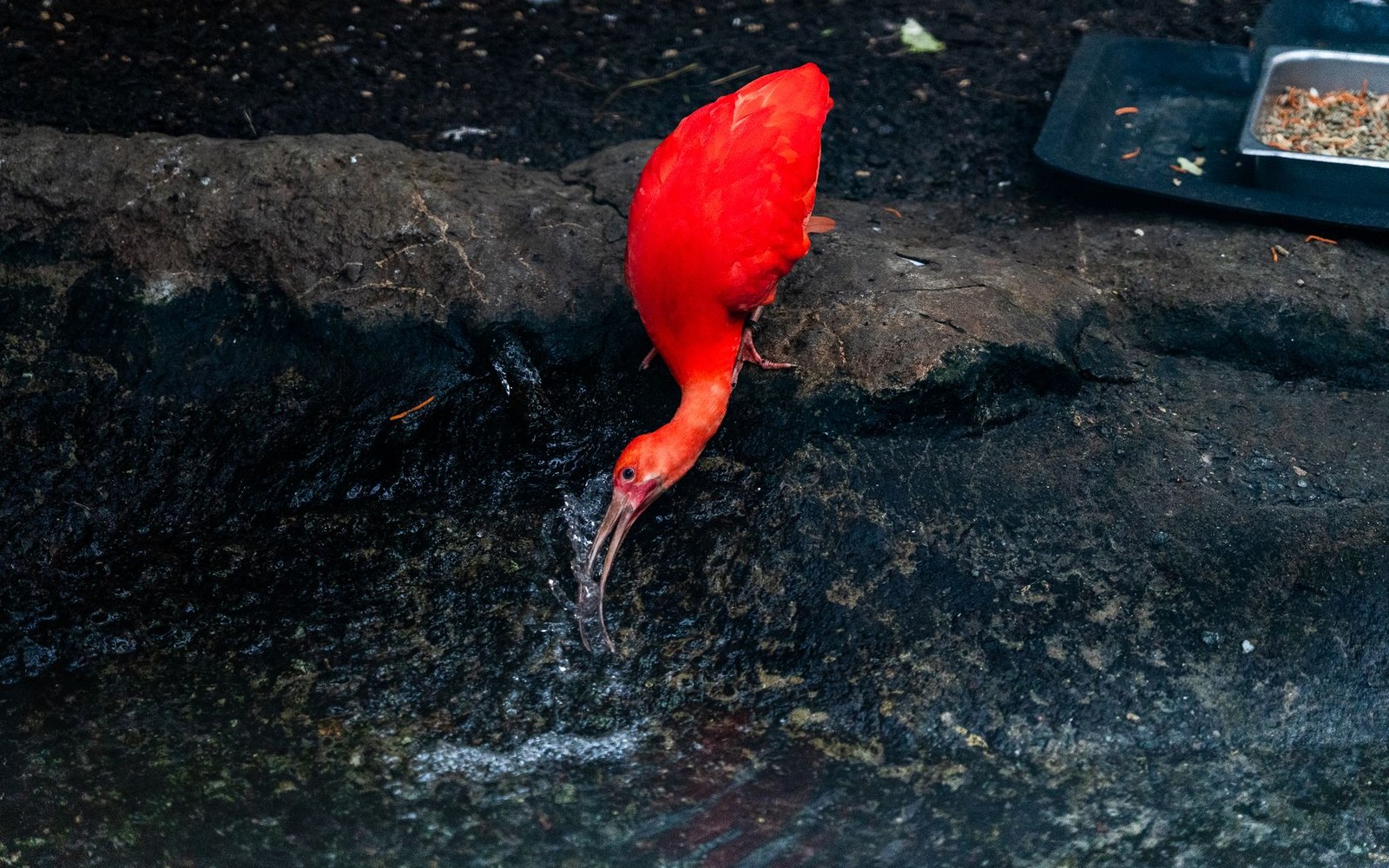
The Bird That Carotenoids Built
The scarlet ibis (Eudocimus ruber) is celebrated in Venezuela alongside the turpial, the national bird, an unusual pairing that places two of the most visually striking birds in South America on the same symbolic pedestal. The ibis holds the mangrove; the turpial holds the canopy. Together they represent Venezuelan avifauna's chromatic extremes.
The ibis's colour is not synthesised by the bird itself — it is dietary. Every shade of red-orange, from the pale flush of a juvenile to the near-crimson of a fully mature adult, derives from carotenoid compounds absorbed through a diet of crustaceans, molluscs and aquatic invertebrates. Remove those food sources and the plumage fades measurably within a single moult cycle. The only feathers that resist this rule are the wingtips, which carry a small patch of iridescent black — the bird's sole pigment-based marking.
Breeding adults reach roughly 56–61 centimetres in length. The bill is long, strongly decurved, and used to probe soft mud and shallow water with a tactile efficiency that sight cannot replicate in turbid conditions. Nesting is colonial and often mixed, with the snowy egret (Egretta thula) a common neighbour on the same island roost.
Where the Venezuelan Population Concentrates
Morrocoy National Park, established in 1974 on the Falcón coast, holds one of the most consistently documented roost sites in the country. The Llanos wetlands — seasonally flooded to depths sufficient to support the dense invertebrate communities on which the ibis depends — function as the interior counterweight, particularly during the wet season when shallow water spreads across hundreds of kilometres of savanna. IUCN Red List assessments classify Eudocimus ruber as Least Concern, with the global population estimated in the hundreds of thousands, the Venezuelan and Trinidad populations among the most significant.
What distinguishes the Venezuelan birds is partly geography and partly scale. The Orinoco Delta and the mangrove coast each provide structurally different foraging environments, and Venezuelan flocks move between them with the flood cycle. At dusk, the return to roost is one of the more reliable spectacles in Neotropical birdwatching: columns of red crossing a grey sky above the mangrove canopy, visible from considerable distance before the birds settle.