Where It Stands, and What It Needs
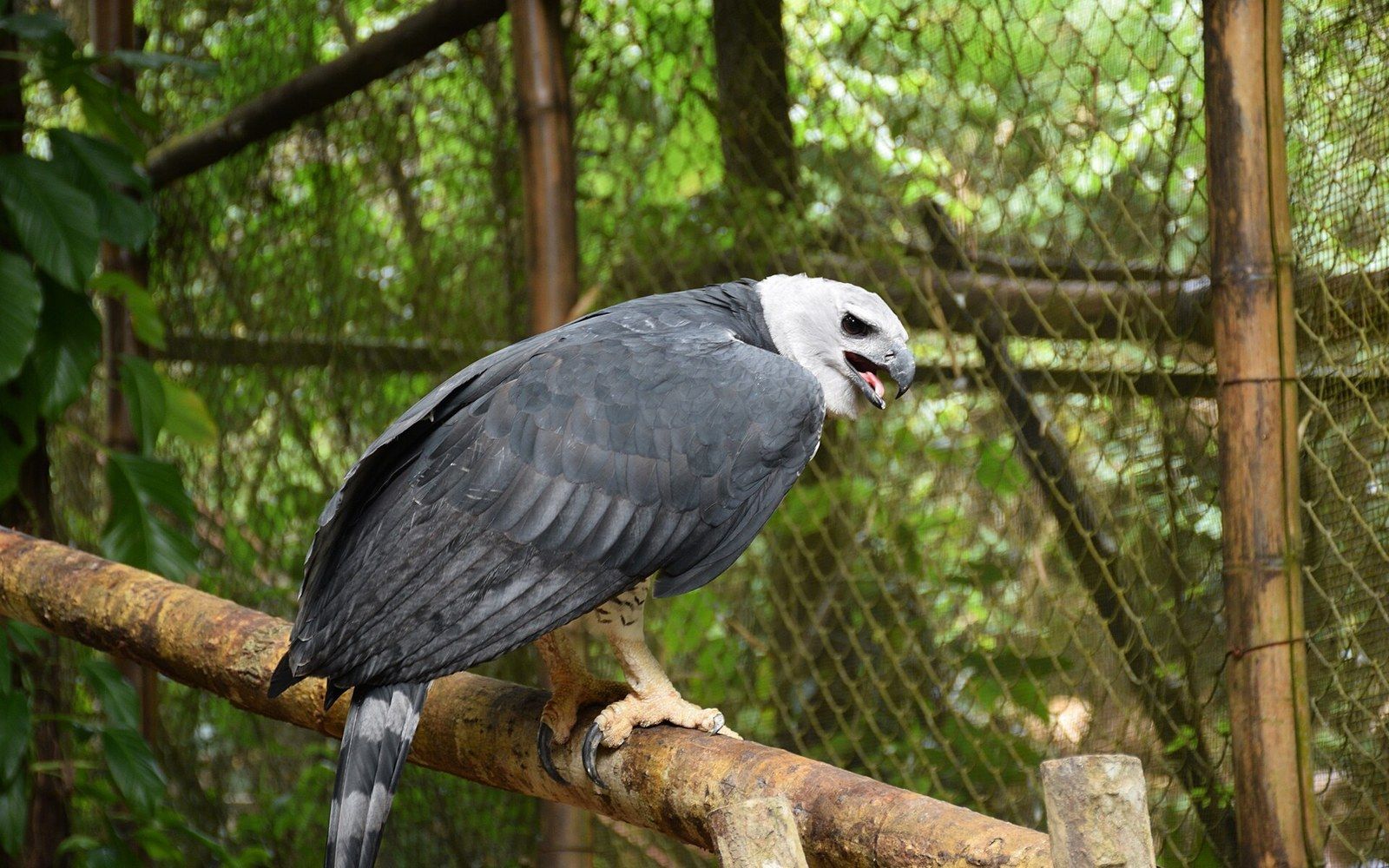
The harpy eagle (Harpia harpyja) is the largest raptor in the Western Hemisphere by mass, with a wingspan reaching up to 224 centimetres and females — consistently larger than males — weighing up to nine kilograms. Those dimensions are matched by a territorial appetite that makes the species acutely sensitive to forest loss: BirdLife International's species account documents each breeding pair requiring between 4,000 and 10,000 hectares of continuous closed-canopy forest, a range that must remain largely undisturbed across a multi-year nesting cycle, since pairs breed only once every two to three years.
In Venezuela, two populations carry most of the remaining breeding evidence. The Imataca Forest Reserve in Bolívar state — a lowland humid forest block covering roughly 3.7 million hectares on the Guiana Shield — retains documented harpy presence, though surveys have recorded nesting density as sparse relative to historical accounts. The second and more significant stronghold lies within Canaima National Park, whose 3 million hectares of forested tepui foothills and river valleys provide the undisturbed canopy structure the species requires. Harpy eagles hunt almost exclusively beneath the closed canopy, taking sloths and monkeys by direct aerial ambush, which means any fragmentation that reduces mid-storey continuity effectively eliminates the habitat regardless of total forest area on a map.
The IUCN Red List assessed Harpia harpyja as Vulnerable in 2021, citing a continuing population decline driven by deforestation across its range from southern Mexico to Bolivia. Venezuela's historical distribution, as reconstructed from museum records and nineteenth-century naturalist accounts, extended across much of the Orinoco's southern forested bank, the entire Amazonas state, and into Zulia and Barinas wherever gallery forest offered sufficient depth. That arc has contracted substantially; the species is now considered absent or only occasionally recorded in the llanos edge forests and the northern cordillera, where hunting pressure compounded clearance for agriculture during the twentieth century.
Nest detection remains the primary survey tool. Harpy eagles construct large stick platforms, typically 40 to 75 metres above ground in emergent trees, and reuse them across years — making confirmed nests among the most reliable population indicators available to field researchers. The Canaima and Imataca records held by BirdLife's global database for Harpia harpyja represent the core of what Venezuela still holds, and the conservation case for both areas rests, in part, on their role as refugia for this bird.