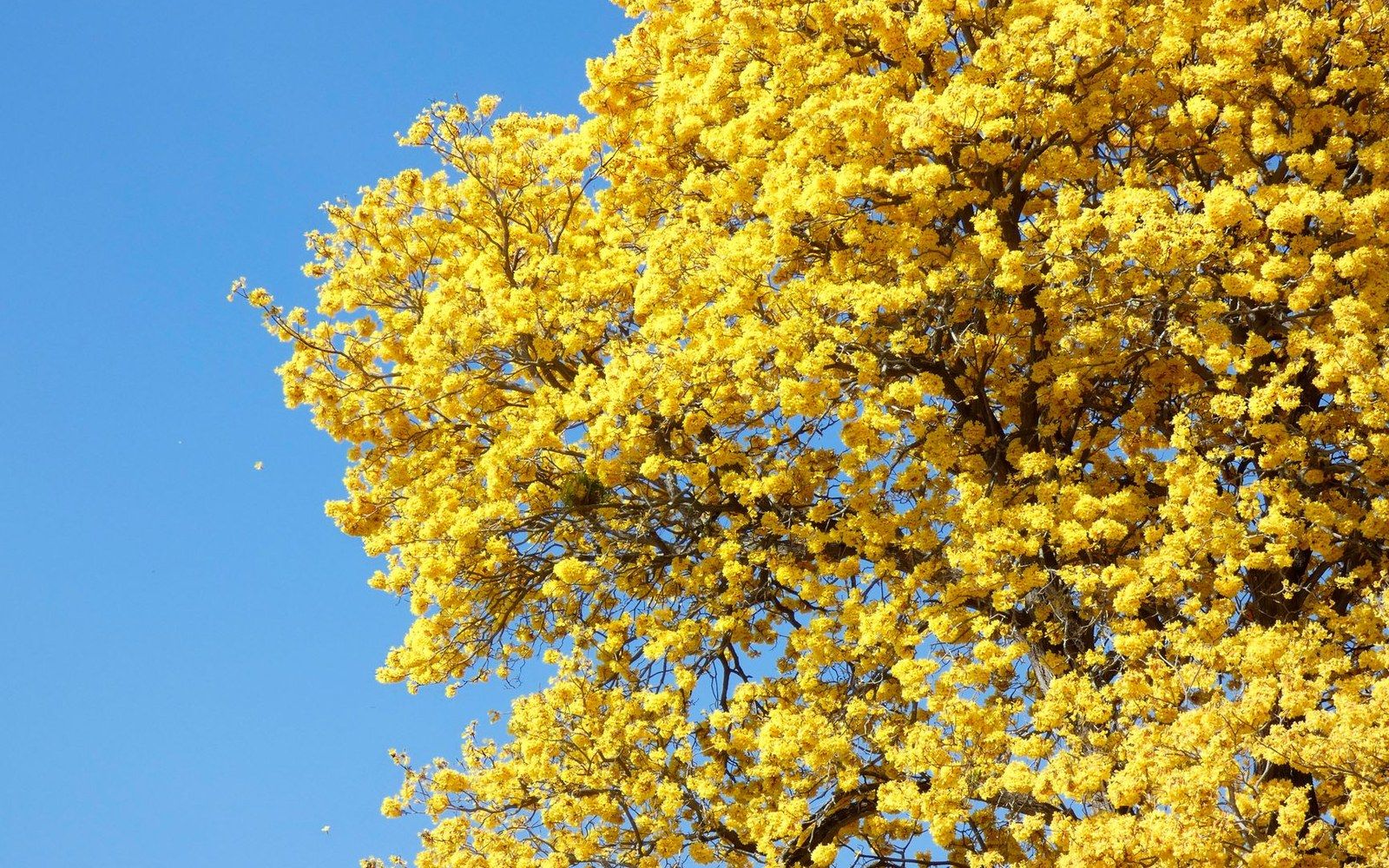
A Phenological Trick Written Across the Landscape
The araguaney — Handroanthus chrysanthus, long catalogued under the synonym Tabebuia chrysantha — flowers in a burst of synchronized mass bloom while its branches are still bare. The mechanism is climatic: a spell of rain following the extended dry season triggers near-simultaneous flowering across entire hillsides and Llanos edges, producing the effect that made the species Venezuela's national tree by presidential decree in 1948. Within days of that first rain, every araguaney in a given area opens its tubular golden flowers together; within two weeks the display fades and leaves emerge, as though the tree has exhaled.
The effect is most dramatic in the Andean foothills between Mérida and the central ranges, and along the transitional belt where the Llanos meet higher ground. Stands of araguaney read from a distance as pure yellow against red laterite soil or pale sky — a phenomenon remarked upon by botanical travelers since Alexander von Humboldt and Aimé Bonpland passed through Venezuelan territory during their 1799–1800 expedition, when the tree's synchrony was already a recognized local landmark.
Herbarium records in Venezuelan collections and at the Real Jardín Botánico de Madrid, which holds significant neotropical holdings from the Iberian colonial period, place H. chrysanthus across an altitudinal range from lowland gallery forest to approximately 2,000 metres. The species belongs to the family Bignoniaceae and reaches mature heights of twelve to thirty metres. Its flowers are five-lobed, trumpet-shaped and a deep chrome yellow; the bark is deeply furrowed and grey. Timber is dense and termite-resistant, historically valued for construction across the Llanos.
The 1948 designation formalized what Venezuelan vernacular geography had long assumed: that the araguaney's annual flowering was a calendar, a weather signal and a spectacle inseparable from the country's seasonal identity.