The Physics of Standing Still
Jesús Rafael Soto was born in Ciudad Bolívar in 1923 and trained at the Escuela de Artes Plásticas in Caracas before moving to Paris in 1950, where he joined the orbit of artists rethinking what a picture could do. His early work engaged optical vibration — parallel lines printed or painted at frequencies that made the surface appear to tremble. But Soto's most consequential discovery was simpler and stranger: you do not need a motor to make art move. You need a body.
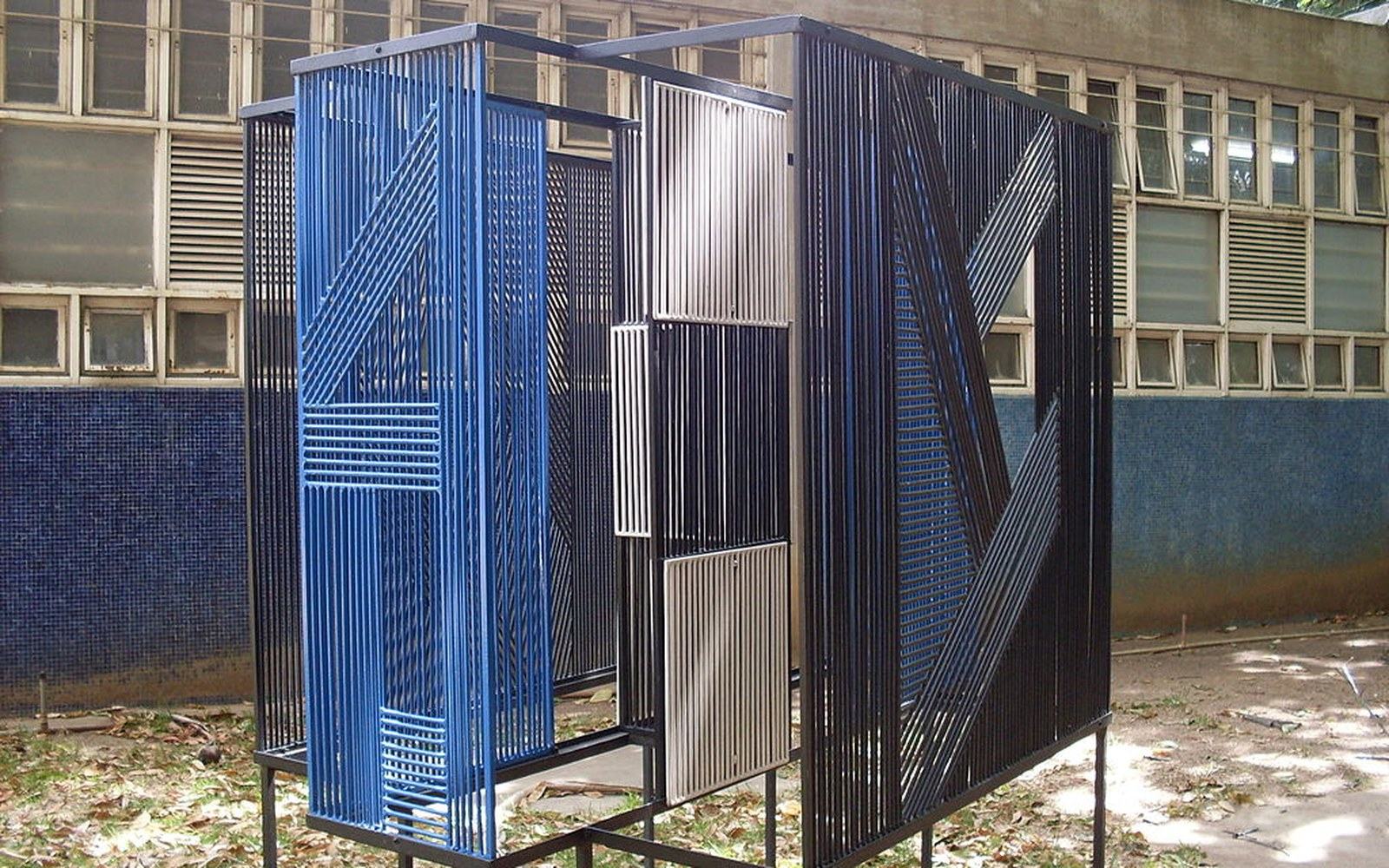
The Penetrables — the name he gave to a series of room-scale installations first developed in the 1960s — consist of thousands of thin vinyl or nylon tubes suspended vertically from a horizontal grid, hanging at uniform length to form a dense, traversable curtain. The tubes are typically yellow, though Soto produced versions in other colours. They hang still. Nothing moves until a viewer enters. As a person walks through, the tubes part, shift, trail, drift back. The work's kinetics are produced entirely by the visitor's displacement of air and mass. Soto described the experience as one of dematerialisation — the boundary between the viewer's body and the work's material becomes genuinely unclear. That is not a poetic claim; it is a physical description of what happens when a human torso moves through a thousand hanging rods.
Paris, 1969, and Ciudad Bolívar, 1973
Soto's international recognition consolidated with a major retrospective at the Musée d'Art Moderne de Paris in 1969, which positioned him firmly within the kinetic and Op Art movements that had been gathering critical mass in Europe through that decade. His Venezuelan contemporary Carlos Cruz-Diez was working in related territory — chromatic instability, optical phenomena — but Soto's move toward full spatial immersion was distinctive: he wanted the gallery body to become the mechanism.

The institution that bears his name opened in Ciudad Bolívar in 1973. The Museo de Arte Moderno Jesús Soto was designed by Carlos Raúl Villanueva — the same architect responsible for the Ciudad Universitaria de Caracas — and holds the most comprehensive collection of Soto's work anywhere, including early optical paintings, Vibrations, Reliefs, and multiple iterations of the Penetrables across several decades. The building's relationship to its collection is not incidental: Villanueva designed the spaces with Soto's work in mind, allowing natural light to behave as an active element inside the galleries.
Soto continued to produce large-scale public Penetrables through the 1980s and 1990s, several of them installed permanently in urban plazas and museum courtyards across Europe and Latin America. He died in Paris in 2005.
Why the Body Is the Point
Kinetic art as a category is often understood mechanically — motors, gears, controlled oscillation. Soto's Penetrables sit at its edge because they refuse all of that. There is no hidden armature making the tubes move on a schedule. The activation is entirely contingent. An empty Penetrable is inert sculpture; a Penetrable with a person in it is something closer to a weather event — localised, directional, impossible to view from outside without watching the effect of the unseen cause.
This is what separates the Penetrables from Op Art proper. Op Art works on the retina; the viewer stands at a distance and the painting does something to vision. Soto's mature installations require proprioception — the body's sense of its own position in space — because the work is happening around and against the viewer's moving skin. The scale of a full Penetrable means that, midway through, the viewer cannot see the edges of the work. They are, briefly, inside the painting, a condition that the flat grid of European modernism had not seriously entertained before Soto walked it through to its logical conclusion in a curtain of yellow tubes.