A Body Built for the Llanos
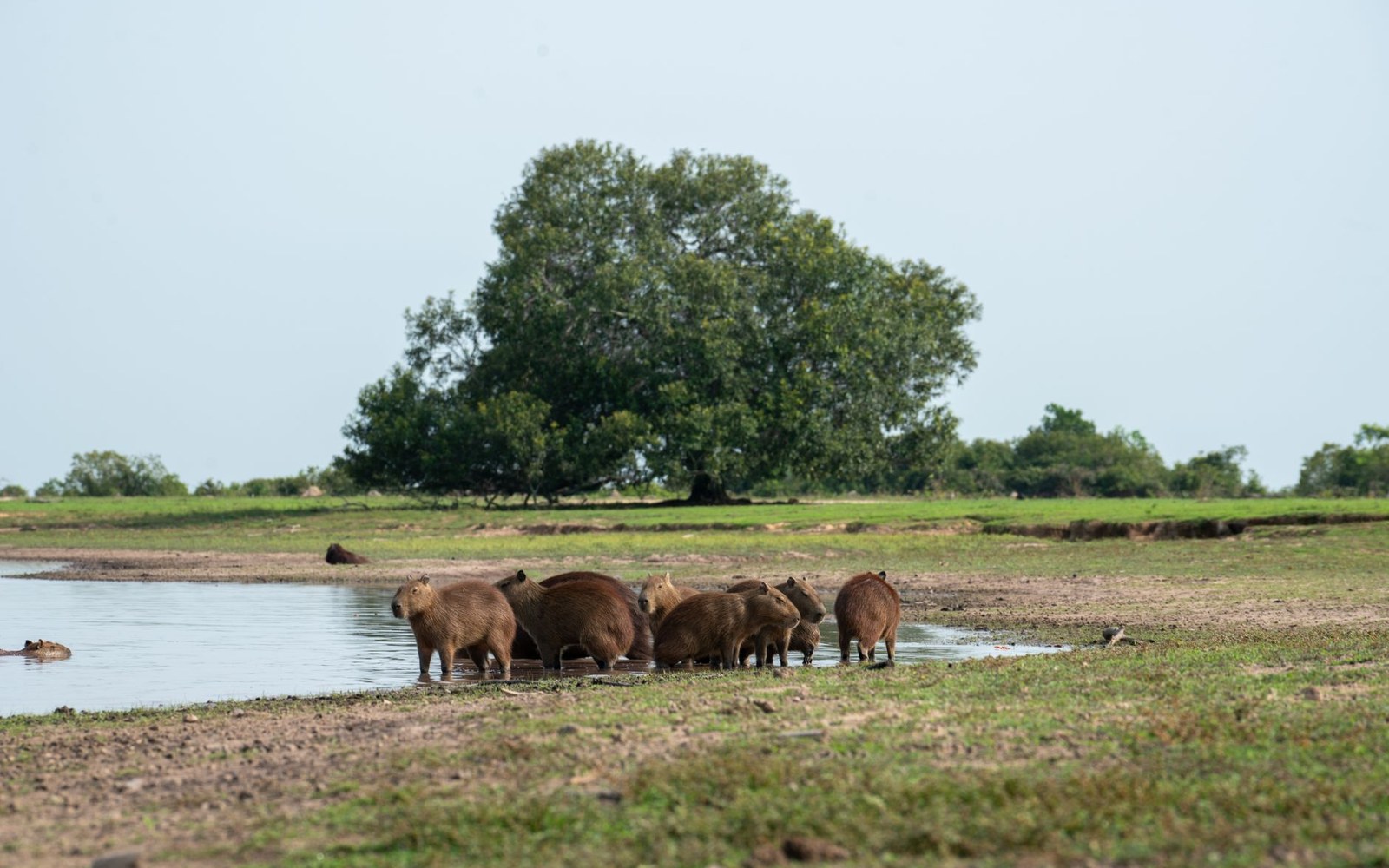
The capybara (Hydrochoerus hydrochaeris) is the largest rodent alive, with adults recorded at up to 66 kg by the IUCN in its species assessment. That mass is not incidental: a semi-aquatic body plan — partially webbed feet, eyes and nostrils set high on a broad skull, dense muscle built for sustained swimming — suits an animal that spends the Venezuelan Llanos flooding cycle half-submerged and the dry season packed shoulder to shoulder around shrinking water holes.
Venezuela's Llanos, the vast tropical savanna draining roughly 300,000 km² of Orinoco basin, holds the densest recorded capybara populations in the species' entire range. During the dry season — roughly November through April — herds of between ten and thirty animals, and occasionally over a hundred, compress into territories around permanent lagoons. A dominant male controls each group; subordinate males and females form the social core, with juveniles drawn tight into the herd's interior where predator pressure is lowest. The spectacled caiman, the anaconda and the jaguar are their principal predators, and the capybara's response to threat is immediate: a warning bark, then the entire herd bursts into water.
When the Water Returns
The wet season transforms the calculus entirely. As the Llanos floods from May onward, the compressed dry-season herds disperse across a suddenly navigable plain. Grasses that were parched and cropped short re-emerge; capybaras move freely across the inundated savanna, grazing aquatic vegetation and spending long midday hours in the shallows to regulate body temperature. Females give birth in this season, typically to litters of four or five pups, which are mobile within hours. The Llanos' seasonality — brutal in its extremes — is precisely what makes it productive for a species adapted to oscillate between crowding and dispersal.
The capybara's relationship with the flood plain is not peripheral but constitutive: the Llanos flooding cycle has shaped the animal's social behaviour, reproductive timing and body condition across generations, making Venezuela's open savannas the benchmark against which every other capybara population is measured.