Engineering a Record
Lake Maracaibo presented a singular problem for bridge designers. The lake — more accurately a tidal bay connected to the Gulf of Venezuela by a narrow strait — carries heavy oil-industry traffic, and its waters had to remain navigable by large tankers. Any crossing therefore needed not only extraordinary length but significant navigational clearance at its centre. The Venezuelan government commissioned the Italian engineer Riccardo Morandi, whose reputation rested on an advanced command of prestressed concrete, the technique in which tensioned steel tendons are embedded within the concrete mass to give it strength that unreinforced concrete cannot achieve alone.
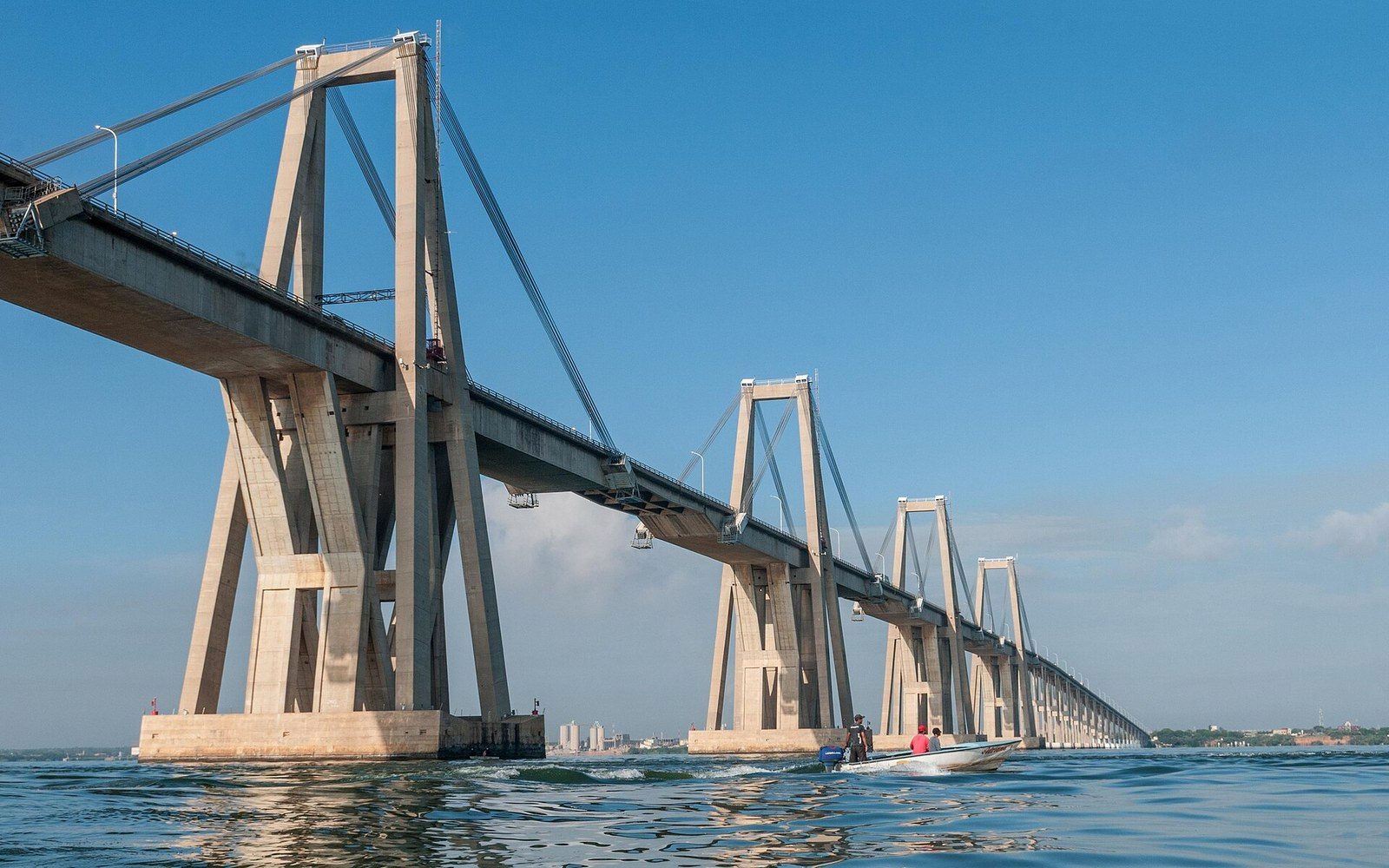
Morandi's solution is immediately recognisable: five identical cable-stayed spans at the centre of the crossing, each supported by a tall inverted-V pylon from which diagonal prestressed-concrete stays fan outward to the deck. The central navigation spans rise to provide approximately 46 metres of clearance above the water, sufficient for the tankers servicing the oilfields whose derricks crowd the surrounding lake. The approach viaducts on each shore — long, repetitive runs of prestressed-concrete beams on slender piers — carry the total structure to its record 8.7 kilometres. At the time of its opening, no other bridge built from prestressed concrete was longer.

Construction and Chronology
Work began in 1957, the contract awarded to an international consortium that brought in Morandi's own office for the engineering design. The construction period coincided with a phase of intense national investment in infrastructure, and the bridge was conceived partly as a practical connector between Maracaibo — Venezuela's second city and the capital of Zulia state — and the rest of the country, which the lake had always kept at arm's length. Before the bridge, vehicles crossed by ferry, a bottleneck entirely at odds with the scale of the petroleum economy growing on the lake's shores.
Five years of work across open water, involving deep caisson foundations driven through the lake bed, produced a structure of 135 spans in total. The five central cable-stayed spans, each 235 metres long, are the engineering signature; the approach viaducts, though unglamorous, represent the greater portion of the total length and were themselves a considerable feat of repetitive prestressed concrete construction at scale. The bridge opened on 24 August 1962, on a lake whose waters had also seen the 1823 naval engagement that secured independence from Spain.
The structure carried four traffic lanes and was designed to accommodate the continued movement of shipping beneath it — a constraint that shaped every dimension of the central section. Morandi's pylon-and-stay system, with its distinctive diagonal concrete members rather than steel cables, would become his most visible contribution to structural engineering and a model examined by bridge engineers internationally in the years that followed.
Morandi's System
Riccardo Morandi developed his approach to cable-stayed bridges at a time when the form was being rediscovered after decades of suspension-bridge dominance. His preference for prestressed concrete stays rather than the steel cables used by most contemporaries gave his bridges a heavy, sculptural quality quite different from the lighter geometry of steel-cable designs. At Maracaibo, the concrete stays are enclosed in a protective sheathing, a design choice intended to shield the tensioned elements from the corrosive marine environment of a tidal lake sitting in a humid tropical climate.
The bridge was named for Rafael Urdaneta, the Venezuelan general from Maracaibo who served as one of Simón Bolívar's most trusted commanders during the wars of independence. The naming connected the engineering achievement explicitly to regional identity: Urdaneta is Maracaibo's most celebrated historical figure, and the bridge crosses the water that bears the city's name.
The Maracaibo crossing held its record as the world's longest prestressed concrete bridge until longer structures were completed elsewhere in subsequent decades. It remains in use, a functioning monument to a moment when a single Italian engineer's confidence in tensioned concrete produced a structure that the world had not previously seen at that length, thrown across a tropical lake already famous for the oil wealth beneath it.