From El Sistema to the International Stage
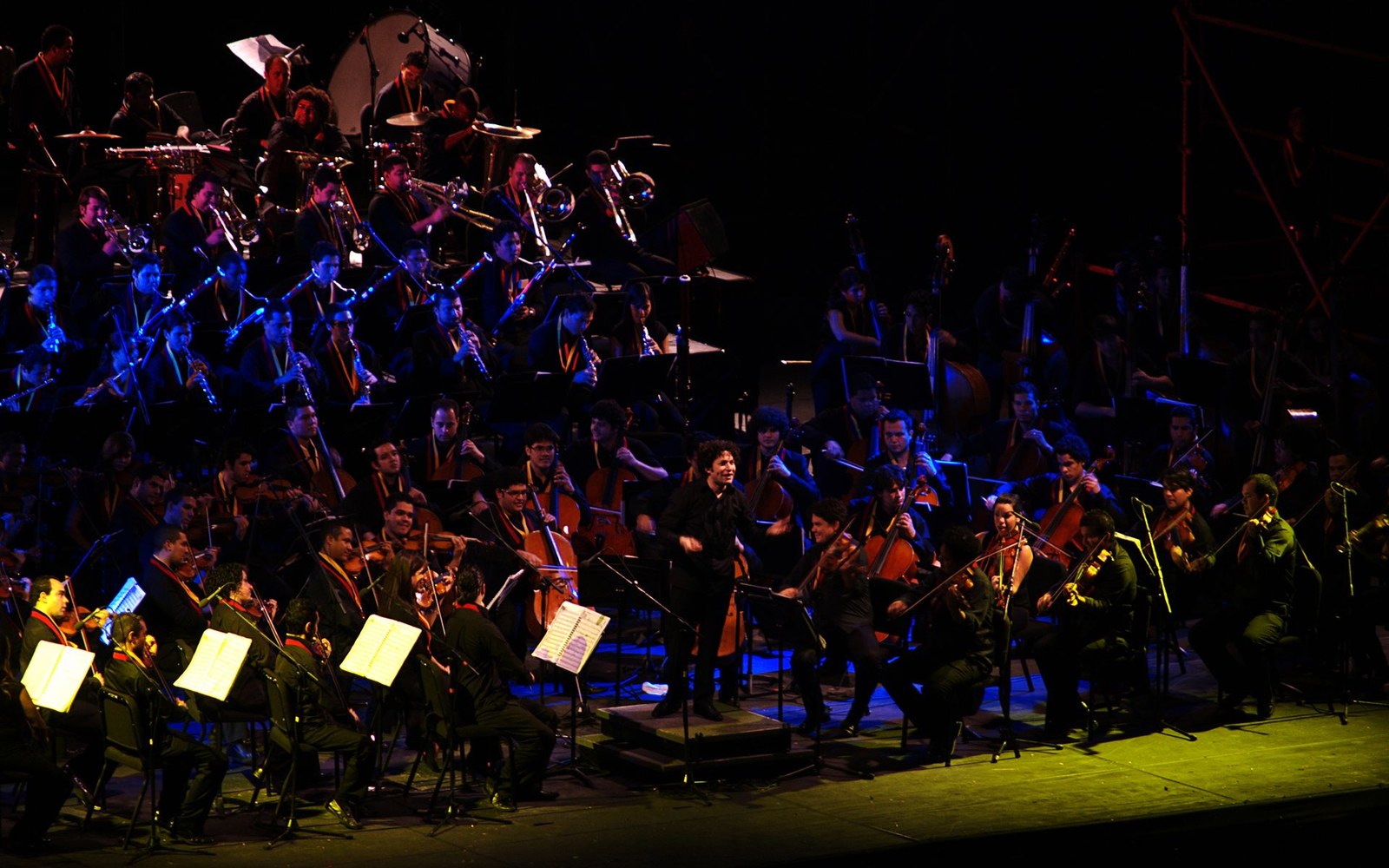
The Simón Bolívar Symphony Orchestra began as the senior ensemble of El Sistema, José Antonio Abreu's state-supported music education programme founded in Caracas in February 1975. What distinguished the orchestra from its earliest decades was not merely its repertoire or discipline but its structural position inside a nationwide pedagogical pyramid: players entered as children in local núcleos (teaching centres), advanced through regional ensembles, and reached the Simón Bolívar as the programme's flagship instrument. That pipeline produced instrumentalists in quantity — and, because conducting was taught alongside performance from the outset, it also produced conductors.
The clearest single demonstration of that output is Gustavo Dudamel. Born in Barquisimeto in 1981, he came up entirely through El Sistema, learning the violin before moving to conducting. In 2004 he won the Gustav Mahler Conducting Competition organised by the Bamberg Symphony in Germany — one of the conducting world's most competitive selection processes — at the age of twenty-three. The prize brought immediate international exposure, and what followed was a series of appointments that traced an upward arc with unusual speed. He took the chief conductorship of the Gothenburg Symphony Orchestra in Sweden in 2007, then became Music Director of the Los Angeles Philharmonic in 2009, the youngest person to hold that post. In 2021 he was named Music Director of the Paris Opera, succeeding Philippe Jordan, making him one of a very small number of conductors to lead simultaneously a major American orchestra and a major European opera house.
The Orchestra Behind the Conductor
Dudamel's career is the most visible thread, but the institutional story is broader. The Simón Bolívar Symphony Orchestra itself built an international touring record from the early 2000s onward, appearing at the BBC Proms, Carnegie Hall and the Berlin Philharmonie, performances documented in contemporaneous press coverage and the orchestras' own records. Those appearances placed Venezuelan musicians — trained entirely within the country's public system — alongside ensembles drawing from globally competitive conservatoire markets.
The conducting pipeline ran deeper than one name. Diego Matheuz, also an El Sistema graduate, became Principal Conductor of the Teatro La Fenice in Venice in 2012. Christian Vásquez has held posts with orchestras in Europe and the Americas. Dietrich Paredes and Manuel López Gómez are among the conducting alumni who have worked with European ensembles. No comprehensive census of El Sistema-trained conductors in international posts has been published in a single authoritative index, but the pattern is consistent enough that music institutions in several countries have cited the programme when designing their own youth orchestra systems, as UNESCO has noted in its documentation of El Sistema's model.
What the programme built, structurally, was a career path that did not require a musician to leave Venezuela to receive serious early training. The density of rehearsal hours in the núcleo system — estimated by researchers at significantly higher weekly contact time than most European youth programmes — produced a cohort comfortable with large-scale symphonic repertoire before conservatoire age. When those musicians eventually did enter the international audition circuit, they carried an unusual depth of ensemble experience.

Mahler, Bernstein, and the Repertoire Question
The orchestra's international programmes have leaned toward the late Romantic and twentieth-century canon: Mahler symphonies, Shostakovich, Bernstein's own works — Bernstein visited Venezuela and maintained a documented connection with Abreu's programme. This was partly pragmatic: the repertoire that showcased large forces and expressive breadth suited an ensemble that had trained in exactly those terms. Dudamel's Los Angeles tenure has extended his conducting range into opera and contemporary commissions, but the Simón Bolívar identity remained rooted in the symphonic tradition it inherited from Abreu's founding vision.
That vision — that systematic, early, intensive orchestral training could produce world-class musicians from any social background — has been the orchestra's most consequential export. The conductors it generated were evidence of the method working at its highest level.