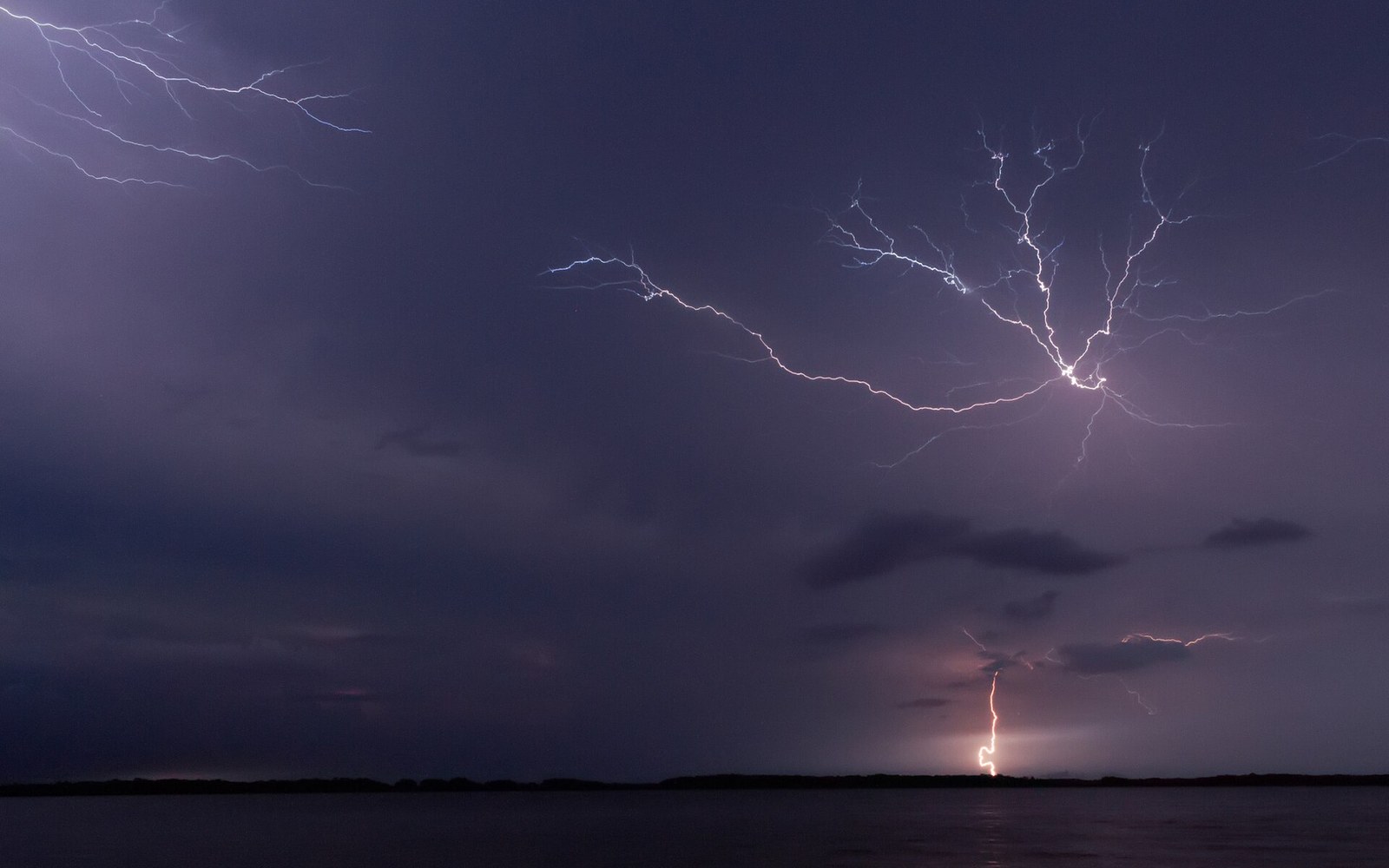
The Mechanism Over the Water
At the southwestern end of Lake Maracaibo, where the lake narrows toward the mouth of the Catatumbo River, an atmospheric collision happens with unusual reliability. Warm, moisture-laden air rises from the lake's surface — a body of water roughly 13,210 km², whose shallows absorb solar heat across the day. By evening, that moist air meets cooler currents descending from three converging arms of the Andes. The mountains channel the winds; the lake supplies the moisture; the result is deep convective uplift that generates cumulonimbus cells of extraordinary persistence.
The storms form most often above the lake's southern end, typically beginning after dusk and lasting into the early hours. They are not a single continuous storm but a recurring system — the same meteorological conditions re-establishing themselves night after night because the topography and thermal regime that produce them do not change. The Andes are always there; the lake is always warm; the nightly land-cooling of the surrounding lowlands reliably drives the air circulation that completes the cycle.
What the Satellites Recorded
The figures come from NASA's Lightning Imaging Sensor and Optical Transient Detector dataset, published in a 2016 analysis by Albrecht and colleagues in the Bulletin of the American Meteorological Society. That study, drawing on satellite lightning measurements from 1995 to 2013, identified the Lake Maracaibo basin as the single highest lightning flash rate location on the planet, at a mean of approximately 232 flashes per km² per year. The 260-nights-per-year figure — the number of nights annually on which the storms occur over the Catatumbo area — comes from the same dataset and has become the most-cited single descriptor of the phenomenon's regularity.

Strike density at the epicentre of activity, measured directly over the lake and the lower Catatumbo basin, reaches concentrations not matched anywhere else in the continuous satellite record. Individual storms produce visible lightning at rates that make the phenomenon effectively continuous to an observer on the southern lakeshore — a persistent, silent-at-distance electrical display that has been noted in navigation records since at least the colonial period, when the light served as a natural reference point for sailors approaching the Gulf of Venezuela at night.
The Physics of Persistence
What makes Maracaibo unusual is not that it produces lightning — tropical lake environments with orographic uplift commonly do — but that the conditions reconstitute themselves so reliably and so frequently. Three factors interact. First, Lake Maracaibo is one of the oldest lakes on Earth (estimates range into the tens of millions of years), with a warm, stratified surface that resists rapid cooling. Second, the lake sits within a topographic basin almost entirely enclosed by the Venezuelan and Colombian Andes on three sides, creating a natural funnel for nocturnal drainage winds. Third, the Catatumbo River's discharge maintains freshwater inflow that modulates surface salinity and temperature gradients within the southern lake — subtle variables that affect local atmospheric instability.
The storms themselves generate between approximately 16 and 40 kiloamperes per stroke at peak current, within the range documented for tropical continental lightning by the World Meteorological Organization. What distinguishes Maracaibo is not the intensity of individual strokes but the sheer frequency and the density of cloud-to-ground strikes across consecutive nights for most of the year. The dry season — roughly January to March — reduces but does not eliminate the activity; even in those months, the system generates storms on a minority of nights.
The phenomenon has no agreed popular name in scientific literature; "Catatumbo lightning" is the geographic designation most commonly used, after the river at whose confluence with the lake the activity centres. The origin of that name is disputed, and the meteorological record makes no claim about etymology. What it does establish, across nearly two decades of continuous satellite observation, is a number: 260 nights. It is the most precisely documented measure of a place where the atmosphere, reliably and measurably, refuses to rest.